IT Operations & Monitoring
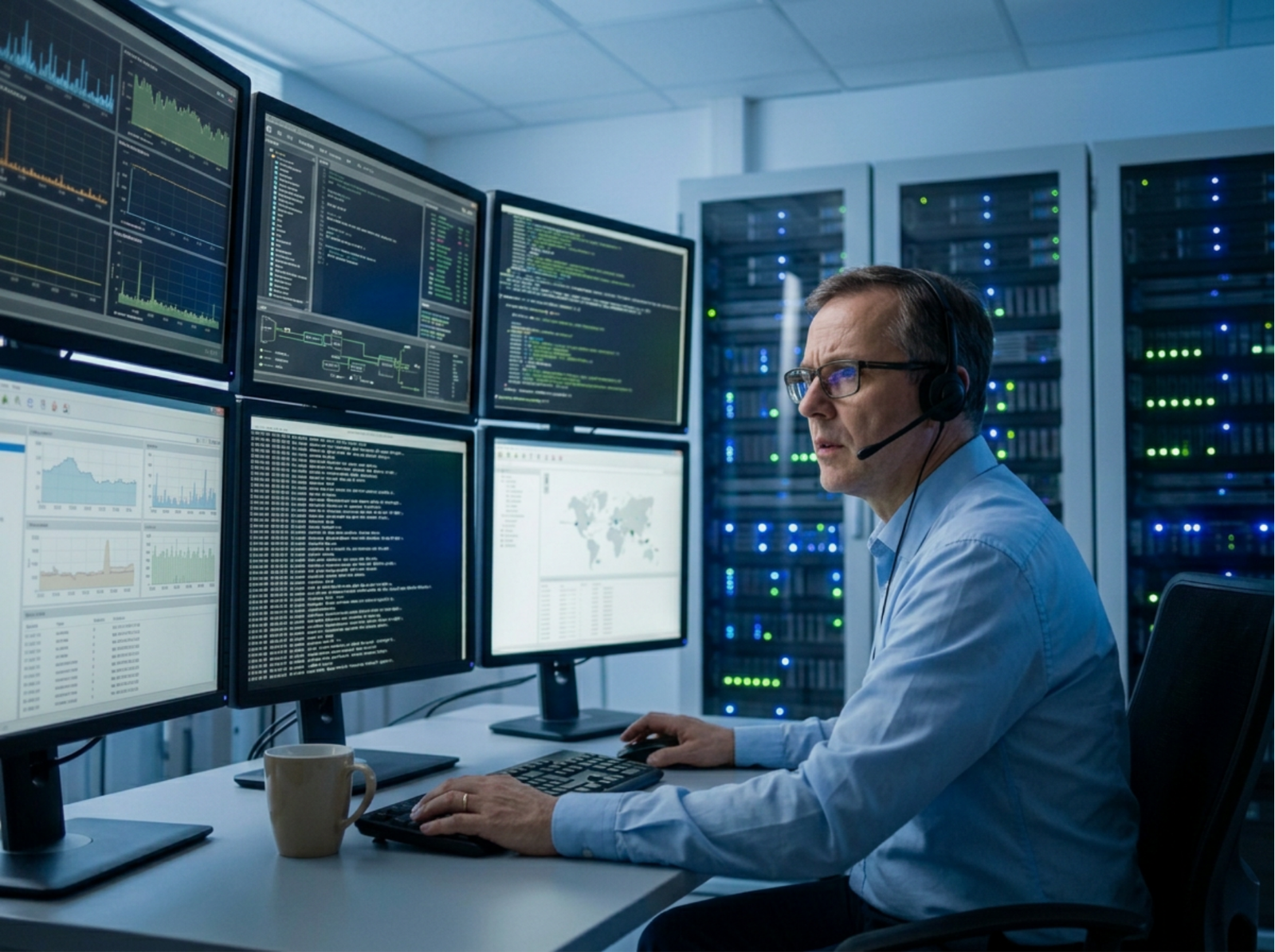
IT Operations & Monitoring is the continuous discipline of watching over
the health, performance, and availability of a business’s entire technology
environment — servers, networks, applications, and cloud services — to
catch and resolve problems before they affect the people relying on them.
Modern IT environments generate a flood of data (logs, metrics, alerts) from
increasingly complex, hybrid infrastructure, and too many teams still learn
about outages from customers before they see them in their own monitoring
tools. IT Operations & Monitoring is what closes that gap.
Major Aspects
- Infrastructure and application monitoring — continuous tracking of servers, networks, databases, and applications for availability and performance issues.
- Observability — unifying logs, metrics, and traces into a single, correlated view, rather than isolated signals from disconnected tools.
- Alerting and incident response — automated detection and notification when something deviates from normal, paired with defined response procedures.
- Capacity and performance management — tracking resource usage trends to plan ahead of demand rather than reacting to it.
- Root cause analysis — identifying the underlying cause of incidents, not just the symptom, to prevent recurrence.
- Tool consolidation — unifying application performance, network, and user-experience monitoring into one platform for faster correlation and clearer visibility.
The Business Value We Deliver
- Fewer and shorter outages — proactive monitoring catches issues before they escalate into visible, business-impacting incidents.
- Faster mean time to resolution (MTTR) — correlated, contextual telemetry helps teams identify root causes far faster than working from isolated alerts.
- Reduced alert fatigue — unified observability cuts through noise, so teams focus on issues that genuinely threaten a business service rather than every raw infrastructure event.
- Better capacity planning — visibility into usage trends prevents both costly over-provisioning and risky under-provisioning of infrastructure.
- Support for hybrid and multi-cloud complexity — centralized monitoring gives a coherent view across on-premises, cloud, and increasingly AI workloads that would otherwise be impossible to track manually.
- Protected budget priority — the large majority of IT leaders expect observability spending to hold steady or grow, reflecting how central this function has become to business resilience.
Modern and Future Directions We Introduce
- AIOps and predictive operations — AI-driven operations are shifting IT from reactive monitoring toward predicting failures and configuration issues before they reach production.
- Agentic AIOps — the first major wave of agent-based AIOps is emerging, with specialized AI agents handling detection, triage, and remediation under shared governance policies.
- Self-healing infrastructure — systems increasingly diagnose and resolve routine issues autonomously, without waiting for a human to act.
- AI-first observability by design — infrastructure and applications are increasingly instrumented from the outset specifically to feed AI models, rather than adding monitoring as an afterthought.
- Rapid platform evolution — a majority of IT leaders are actively reevaluating or switching their core monitoring stack within a 1–2 year cycle, reflecting how fast this space is changing.
- Data authenticity and provenance — as synthetic and machine-generated data blends with real telemetry, verifying the authenticity of monitoring data is becoming a new operational priority.
- FinOps and SecOps convergence — IT operations monitoring is increasingly integrated with cost management and security operations, rather than running as a separate silo.